So here is an update.
Michael end up getting the shipment. He got 5 nice flasher wrasse.
He continued to update me with great level of details every 3 days or so.
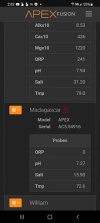
This is sample of the first update he got me when he received the shipment
A heated and ultra aerated tank of 8gal was prepared hours ahead of arrival and its pH adjusted to 7.4.
The fish were acquired and rushed back to the shop QT ASAP.
In complete darkness, the temperature, salinity and pH of one bag was verified. 21.5°C, 1.026 and 6.82, respectively. The test bag was immediately resealed to avoid carbonic acid developed from accumulated CO2 to turn back into CO2 and off-gassing. CO2 escaping will cause a rapid rise in pH which will be terrible for the fish. The fish have been in the bags for many days slowly acclimating to hypoxic and acidic conditions, which ionizes ammonia(NH4) to ammonium (NH3-) which is nontoxic. Over time they have also been filling their tissues with cortisol and lactic acid from stress and the lack of activity. Increasing pH will cause free ammonium inside the body to become ammonia and cause catastrophic organ damage that may not show for weeks, so it cannot be raised rapidly. Light is extremely stressful to fish in distress and after long periods of darkness and performing the acclimation while the fish sleep and are relatively unaware is most optimal. Changes in water chemisty and osmoregulation utilize vast amounts of energy, which needs oxygen. Warmer water reduces the water's oxygenation and speeds metabolism, so colder water is better. Fright and rapid movements increases oxygen consumption drastically, and can starve the fish of oxygen regardless of the oxygen content.
Acetic acid (to reduce pH) and methylene blue (to increase the oxygen binding capacity of hemoglobin) was immediately added to the quarantine tank and adjusted downward to 6.82 at 22.5°C and 1.020.
The fish bags were then cut open and the fish immediately removed and placed into their new tank.
It is well aerated by a high pressure air pump and an air stone.
The acetic acid is oxidized by the air and slowly breaks down into OH- and CO2, which then gets off-gassed, and the water pH will then rise back up naturally over time. This happens simultaneous to the ammonium diffusing out of the fish and into the large volume of new water, where it's then neutralized by Fritz Complete/Prime, and the fish is never exposed to ammonia during its acclimation. After 1 hour, the pH increased to 7.25, and then 7.35 after 2 hours. It is preferable not to exceed a 0.3 chance of pH per day if possible. But, the fish obviously cannot survive terribly long in acid.
During this entire time, the fish is seemingly asleep and nearly non-reactive to basic stimuli. As the sun comes up over the morning gradually to light the building, they will hopefully wake up happy without a rapid light shock . Fish do have circadian clocks and absolutely show signs of jet lag, and that must also be recovered from.
They will not be fed. Eating uses much oxygen which must be reserved for the body to re-osmoregulate itself and recover.
Over the next few days, they will be adjusted to new clean unadulterated saltwater which will raise pH some more.
It is too early to treat them with any medications, however I keep 5mg/gal of Chloroquine in my stock QT water which isn't an issue.
They will get either a malachite or peroxide bath after they are well adjusted, if no lesions are present, and then moved to a larger tank. They will then start off with a 50% dose of metronidazole and fed some metro-bound food, and gradually exposed to continuing CP until/unless adverse reactions show. Fish typically not able to tolerate CP can be adjusted to it nevertheless when done with extreme caution and precise dosing.



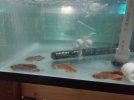
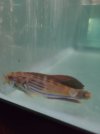
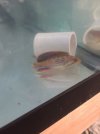
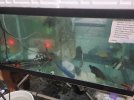
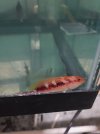
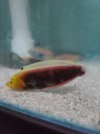
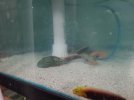
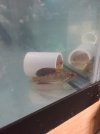


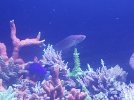

 But the Hooded Flame Wrasses are pretty awesome and regularly available now.