

Guest
- Joined
- Apr 10, 2014
- Messages
- 2,912
- Thread Author
- #1
Just wanted to share my set-up/protocol for acclimating and dipping corals.
So as most of you know, one of the main rules for putting new corals into your tank is.......YOU GUESSED IT.
DIP and INSPECT THAT CORAL and ITS BASE.
There are a number of pest species that can enter your reef tank and kill everything in your tank or make it so ugly you want to quit. Examples: Aptasia anemones which multiply and sting corals, Bryopsis algae which grows like a weed and is really hard to get rid of, bubble algae, coral-eating fireworms, acropora eating flatworms, montipora eating nudibranchs, zoanthid-eating spiders/snails. You get the idea. Blindly putting corals in your tank is like making love with a stranger. You don't know what you might catch.
So where do I start? After getting a new coral (from the store, your friend, frag swap) I inspect the coral for any obvious pest species. Afterwards, I try my best to take the coral off of the fragplug/rock. I use everything I have which includes scapels, exacto knives, bone cutters, and a dremel. Sometimes you can't get it off the frag plug. Oh well. Do your best. Don't kill your coral. A good rule is that if you remove most of the substrate that the coral is on, there's less hiding places for pest species. Afterwards, I put the coral on a NEW fragplug or rock.
So here is my plastic container. I've measured where it holds 1000mL, using a measuring cup.
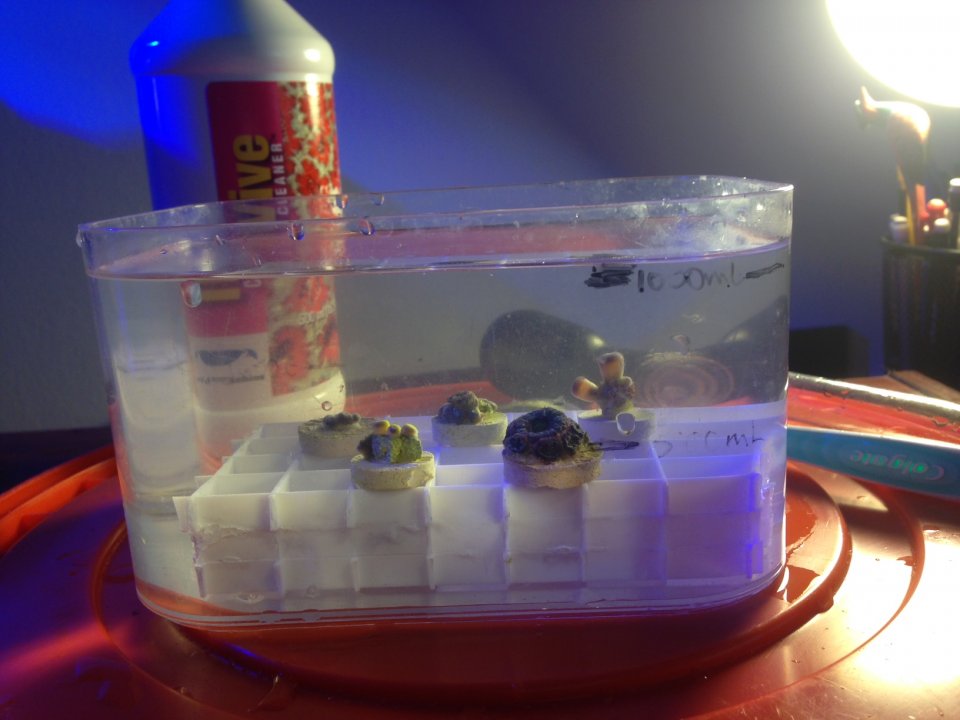
1000mL = 0.26 gallons
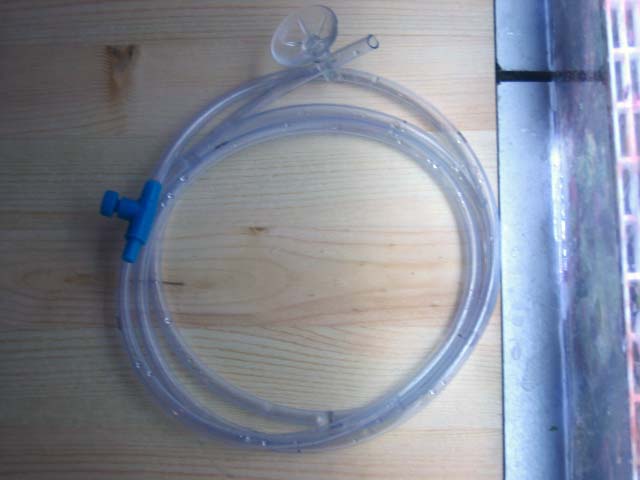
I put the coral in the cup and drip acclimate using your standard tube/valve. I do this for a while until the salinity matches my tank. Usually have to pour out some water from the cup once if the salinity is off.
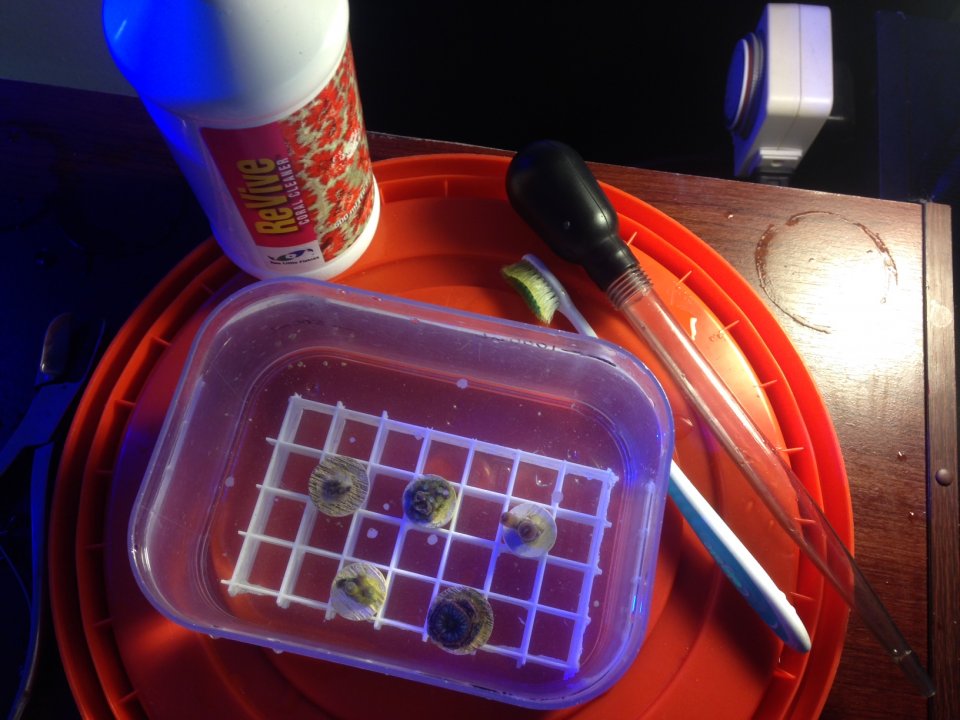
I use revive as my dip so I only have to put one cap full into the container. Then I stir the dip with the water.
The white plastic things are two pieces of eggcrate (aka light diffusers) glued together to hold frag plugs so that they stand up and aren't flying all over the place when I blow with the turkey baster.
While I'm blowing the coral with the turkey baster, I watch to see what flies off. If the motherlode of all flatworms comes flying off of a big rock of coral, I would take precaution and set up a quarantine tank or throw it away...or sell it to someone you don't like. Just kidding, don't intentionally give people pests!
EGGS OF PEST SPECIES USUALLY SURVIVE MOST DIPS. This is where you need to visually inspect frag plugs/rocks/etc. Scrape those eggs off and keep an eye on it. Repeat dips if you have to.
So there's my quick write-up on dipping. I'm glad to say I have almost no coral pests in my tank. A few bristleworms. Some hair algae which I've defeated but nothing else really. I started with live rock which was cured in bleach.
Sometimes I dip my corals when they are not healthy looking (e.g., not opening when all other corals are doing fine). That's what I was doing today for some zoas that haven't opened when all other zoas were happy.
So as most of you know, one of the main rules for putting new corals into your tank is.......YOU GUESSED IT.
DIP and INSPECT THAT CORAL and ITS BASE.
There are a number of pest species that can enter your reef tank and kill everything in your tank or make it so ugly you want to quit. Examples: Aptasia anemones which multiply and sting corals, Bryopsis algae which grows like a weed and is really hard to get rid of, bubble algae, coral-eating fireworms, acropora eating flatworms, montipora eating nudibranchs, zoanthid-eating spiders/snails. You get the idea. Blindly putting corals in your tank is like making love with a stranger. You don't know what you might catch.
So where do I start? After getting a new coral (from the store, your friend, frag swap) I inspect the coral for any obvious pest species. Afterwards, I try my best to take the coral off of the fragplug/rock. I use everything I have which includes scapels, exacto knives, bone cutters, and a dremel. Sometimes you can't get it off the frag plug. Oh well. Do your best. Don't kill your coral. A good rule is that if you remove most of the substrate that the coral is on, there's less hiding places for pest species. Afterwards, I put the coral on a NEW fragplug or rock.
So here is my plastic container. I've measured where it holds 1000mL, using a measuring cup.
1000mL = 0.26 gallons
I put the coral in the cup and drip acclimate using your standard tube/valve. I do this for a while until the salinity matches my tank. Usually have to pour out some water from the cup once if the salinity is off.
I use revive as my dip so I only have to put one cap full into the container. Then I stir the dip with the water.
The white plastic things are two pieces of eggcrate (aka light diffusers) glued together to hold frag plugs so that they stand up and aren't flying all over the place when I blow with the turkey baster.
While I'm blowing the coral with the turkey baster, I watch to see what flies off. If the motherlode of all flatworms comes flying off of a big rock of coral, I would take precaution and set up a quarantine tank or throw it away...or sell it to someone you don't like. Just kidding, don't intentionally give people pests!
EGGS OF PEST SPECIES USUALLY SURVIVE MOST DIPS. This is where you need to visually inspect frag plugs/rocks/etc. Scrape those eggs off and keep an eye on it. Repeat dips if you have to.
So there's my quick write-up on dipping. I'm glad to say I have almost no coral pests in my tank. A few bristleworms. Some hair algae which I've defeated but nothing else really. I started with live rock which was cured in bleach.
Sometimes I dip my corals when they are not healthy looking (e.g., not opening when all other corals are doing fine). That's what I was doing today for some zoas that haven't opened when all other zoas were happy.
Last edited:


 but man those two weeks had to have been rough.

